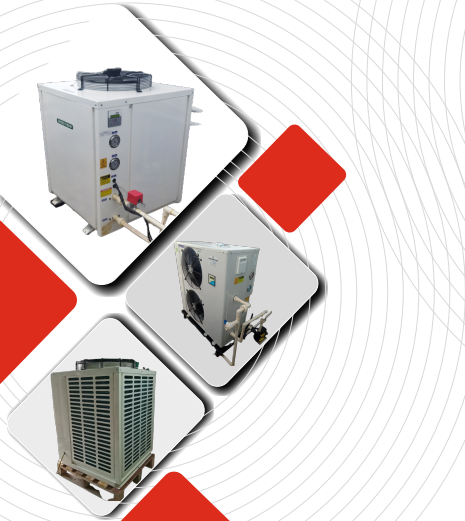



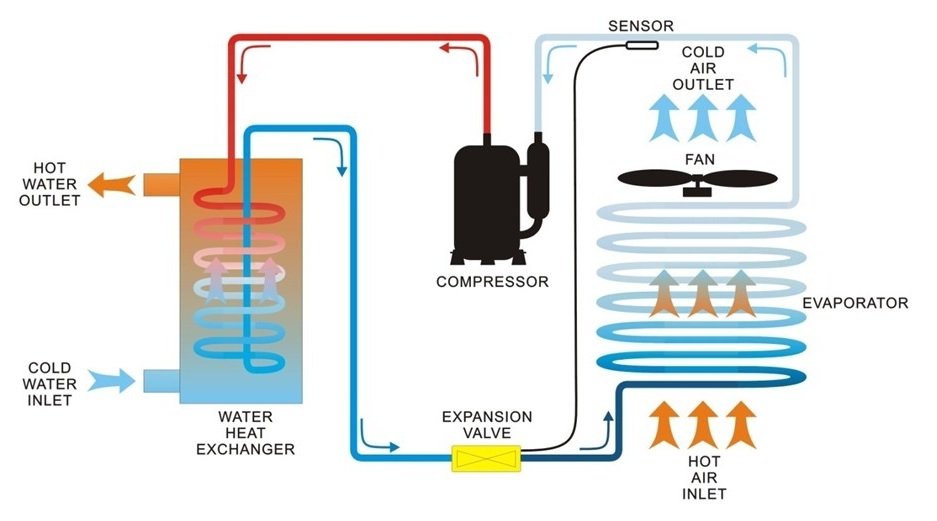
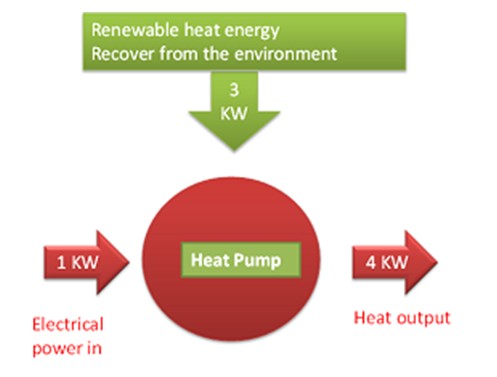
- 75 % of the energy is taken from the environment i.e. from air and transferred to the heat pump.
- 25 % of the energy is sourced from regular electricity. This is used to operate the heat pump, not to heat the water.
- The energy from air is transferred to the refrigerant inside the heat pumps evaporator. This causes the temperature of the refrigerant to rise and change state from liquid to gas.
- The refrigerant gas then compressed, using an electrically driven compressor, reducing its volume but causing its temperature to rise significantly.
- A heat exchanger (Condenser) then extracts the heat energy from the hot refrigerant to heat water.
- After giving up its heat energy, the refrigerant turn back into a liquid and is able to absorb energy from the environment, allowing the cycle to begin again.
The efficiency of heat hump is measured in terms of “coefficient of performance” (COP). Approximately 75 % of the energy needed for heating comes from the ambient. This means for every 1KWh of electrical input used to power the heat pump, up to 4 KWh of heat energy is simultaneously produced, resulting in phenomenal COP.
Silent Features & Advantages
- Energy saving heat pump system saves up to 75% of your water heating costs.
- Occupies Very small Space as compared to solar water heating system.
- Independent of solar radiation.
- Easy operation and very low maintenance.
- No carbon emissions
- Capable to deliver hot water even at subzero temperature
- Easy installation with smart techniques to prevent heat loss.
- The efficiency up to 400%
- Operate irrespective of climatic condition
- Compatible with solar PV for generation
Economic Benefits of Heat Pump
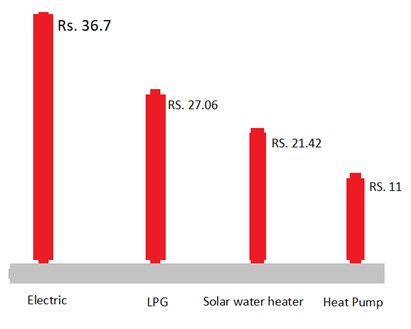
Operating cost per 100 Liters of hot water:
- Reduce water heating cost up to 75%
- Quick ROI as compared to conventional electric geyser
- Round the clock hot water
- Long product life
- Reduced carbon emissions
- Silent operation
- Negligible maintenance cost
| (D) Heat Pump Operating Cost Comparisons | |||||
|---|---|---|---|---|---|
| Parameters | Unit | Electric Geyser | LPG | PNG | Heat Pump |
| Quantum to be Heated | Liters | 5000 | |||
| Specific heat of water | 4.186 | ||||
| Cold water Temp. | °C | 20 | |||
| Hot water Temp. | °C | 50 | |||
| ΔT | °C | 30 | |||
| Heat Required | Kcal | 150000 | |||
| Efficiency | % | 95 | 90 | 90 | 350 |
| Calorific Value | 11200 | 8400 | |||
| Power Required | Kw | 174.42 | 174.2 | ||
| Power Consumption | Kwh | 183.60 | 49.83 | ||
| Heat Delivered | Kcal/Kg | 10080 | 7560 | ||
| Total Fuel Required | Kg/Ltrs. | 16.5 | 22.05 | ||
| Cost/Unit | Rupees | 10 | 95 | 51 | 10 |
| Total Cost / Day | Rupees | 1836 | 1571 | 1124 | 498 |
| Total Cost / Month | Rupees | 55080 | 47123 | 33730 | 14950 |
| Total Cost / Year | Rupees | 660960 | 565476 | 404760 | 179400 |
| Saving Per Annum Against Geyser | Rupees | 0 | 481560 | ||
| Saving Per Annum Against LPG | Rupees | 0 | 386076 | ||
| Saving per Annum against PNG | Rupees | 0 | 225360 | ||